Showing posts with label IHP. Show all posts

Thursday, March 8, 2007

Fishing Communities near Trivandrum, Kerala (2007)


Tomorrow we leave for China. We've just arrived in Bangalore from Mysore, which was the last stop on our 7 day vacation. Things change; plans are never concrete. For me, the best part of this vacation was the time we spent just outside of Trivandrum in Thumba, a fishing community near the southern tip of India. Here was an entire community that had lived intimately, with each other and with the sea, for many generations. Fishermen went out with their nets, often in little more than a few strapped-together pieces of wood, and spent the night on the sea. It was beautiful, but the prevailing sense from the community was that things were changing rapidly.

The 2004 Tsunami, even though it never hit this side of the coast directly, dramatically reduced the catches. Large trawlers with bigger nets catch all the big fish, and it seemed as if these fishermen were left to clean up the scraps. It was depressing to see a man come back after an entire night of fishing, alone, with nothing more than a few pathetic looking fish.


About a week earlier, we had met some fishermen who had come up to Thrissur in northern Kerala to talk about the hard times they had fallen in. They came with Peter, the local politician who represented their community. A couple of students asked if it would be possible to join these fishermen. At the time, I honestly didn't take their plight too seriously; it all seemed so abstract. Sitting in that large forum in a 3 star hotel, it was difficult to imagine the dangers these fishermen faced-- the raging sea, the eroding coastline, the water pollution, the shrinking fish supply. Our original intention was to go nightfishing with the fishermen, and it was only when we arrived at Peter's home did I realize the potential danger of doing so. The last thing I wanted was to drown, at night, in the middle of the Arabian Sea with fishermen who didn't speak English. Ultimately, though, the Sea Gods (or Peter, I suspect, who understandably didn't want to be responsible for the deaths of a bunch of clueless American students) would not let us go off to the sea.


The first night, they said the sea was too rough. The second morning, they said that the fishermen said that the catch wouldn't be big enough to justify a fishing trip. Thus ended our fruitless attempts at nightfishing.

We were also lucky enough to go to one of the morning markets where they sold fish. At 5 AM, before the sun rose, we arrived at a fishing market where trucks would come in with the previous night's catch. Some trucks arrived from Tamil Nadu and beyond, perhaps because of the dwindling fish supply in Kerala. As each truck pulled in, men would scramble for the back in what appeared to be an auction for whatever that truck had. The auction took place quickly. Crates flew off the backs of trucks and within five minutes the truck was cleared and the men would scramble for the next truck that came honking in.
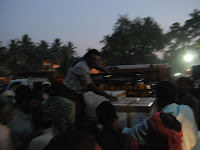


The highest bidder would take the crate of fish, and would often then sell them to venders in other markets.


After that first market, we visited some of the other markets around Trivandrum, where most people would buy their fish. It was still early morning, and fish blood splattered on me when I got close to the fish cutting and cleaning.


Throughout our time in Trivandrum, I was lucky enough to stay in the home of Peter, his wife Magdalen and his daughter Dona. A large percentage of the Malayalam people of Kerala are Syrian Catholics, an esoteric branch of Catholicism I know little about. Apparently, this branch of Christianity has been in Kerala for many centuries, long before the Portuguese arrived with Roman Catholicism. THere are Roman Catholics, who have surnames like Pereira and Saldanha. The Syrian Catholics, at least the ones I met in Kerala, have an interesting tradition where the children take their father's last name as their surname. So Dona's last name was Peter, and my last name would be Fritz. Our family treated us wonderfully, and by the time we left, we all felt that there was an enormous debt that remained unpaid.


Saturday, January 27, 2007

Not much about anything

I'm slightly torn whether I should make this a blog, in the traditional internetty journal sense, or a photo-blog, as it has pretty much been up to now. I'm a terrible writer and have never been able to keep up an interesting journal for either myself or for others. Interesting... being the operative word. So in this post I have decided to experiment with a little bit of both, I will *blog* about my first week with my study abroad program in Boston and will also add some unrelated photos.

This past week's packed schedule has conjured up somewhat unpleasant memories of 8 hour days in high school. Regardless, I've thoroughly enjoyed this past week and have already learned a lot about many things I was previously uninformed about. I'd say that the most enlightening thing we covered was the complexity of insurance schemes, especially the mess that we've made out of health insurance here in the states. Most students seemed pretty convinced that Canada's single-payer system is the best alternative, where the government is responsible for EVERYONE's healthcare, yes, every1, and everyone receives the same care and service. Larry (see below, or as he would say, "See Last!") noted that while many Canadians complain about long waits and other small aspects of their healthcare system, Canadians by and large would not trade it for anything else. Certainly not ours.

You may be asking, what about Massachusett's new healthcare law, which is supposed to provide universal healthcare? Good question. Well, I'm pretty convinced too that the way it is being implemented is not going to work, if providing adequate healthcare and low cost is your goal. I'm not going to get into specifics, but the policy basically works by "filling in" the gaps in patient coverage, and fining those who don't have insurance. Yes, think about that last one.

We have three dedicated and admirable professors who juggle several jobs and literally commute between countries. There is Larry, the affable avuncular (token) MD/MPH who is a model human being. His powerpoint lectures always draw much laughter; during one lecture he made students walk around aimlessly while he talked instead of mindlessly scribbling down his slides. There is Janneli, a midwife/medical anthropologist who has spent a great deal of her life in the rural community of Raramuri in northern Mexico, and apparently has recently been teaching at the WashU college and med school. She has a warm and wonderful laugh and a sweet syrupy voice. Finally there is Ellen, the polemicist. She comes to class with so much energy and enthusiasm for her cause-- creating reasonable labor laws for the world's workers (she works at the UN's International Labor Office/Org.(?) in Geneva). This reminded me of Sebastiao Salgado's excellent photo book, "Workers: An Archaeology of the Industrial Age."

This semester will definitely be challenging. It will force me into situations that I might otherwise avoid and confront realities I might normally conveniently ignore. And it will be difficult, too, for sure. But I am so excited and passionate and eager. Several students were asking on Friday, "will I still care about the problems in the U.S. after three months?" A very good question, indeed, but I feel proud to say that I feel like I've moved beyond that. The kind of 'structural violence' we've talked about is as rampant in India, China, and South Africa as in the U.S. This reminds me of Amartya Sen's graph about life expectancies in Kerala (the state we will be visiting in India, not-so-coincidentally), China, and the U.S., with the U.S. given in terms of Blacks and Whites. Somewhat to my surprise, Blacks in America had a lower life expectancy than both the Chinese and Keralans (?), for both sexes. A higher GDP and higher wages don't necessarily translate to better health outcomes. The point is, while conditions and quality of life in the U.S. may *seem* better for the poor, that isn't necessarily the case. I mean, infant mortality in Harlem is worse than in some "Third World" countries like Cuba. C'mon, U.S. We can do better than that. And as Americans, we have a both a political and moral responsibility to do something about it.

Perhaps the most important thing that I've gotten out of this first week is the reaffirmation that public health is not, in fact, a commodity. STOP PRIVATIZING HEALTHCARE!!! We need to stop treating it like it's something that can be traded and bought for the highest price. It seems like a truism to restate that healthcare is a public good, and for that matter, so is public health. The funny thing is, most people would answer "Yes" to the question of whether or not we should have universal healthcare. This is not to say private practices can't exist. But a comprehensive public one MUST exist.

It might also be worth noting that a single-payer system in which the gov't pays for universal healthcare would be more expensive. It won't be. We spend a lot of money already on healthcare, often on treatment that doesn't work. The money we spend for healthcare goes to private insurance companies that have responsibilities to their shareholders, and many insurance companies have essentially bribed doctors to NOT treat patients. Essentially, if a doctor can convince a patient to forego treatment, the insurance company won't have to pay the doctor as much, but pays the doctor enough so that the doctor makes money and saves time. And doesn't treat the patient. Go capitalism. A single-payer system would get rid of all those nasty insurance companies that make life so difficult when you get sick.

Don't get me wrong, I love capitalism, it has given me a computer, camera, and other wonderful technological wonders I hold dear to my heart. Without these gadgets I wouldn't be able to share with you the photos below. Perhaps you'd have wished capitalism didn't exist after you see these pictures, but I hope that's not the case. So here are the pictures, whether you wanted them or not:


My grandma's apartment on Liberty Ave in Queens, NYC.


Another attempt at a photo posted previously:


My grandma lives above Chopsticks, a restaurant my uncle opened ages ago. It is a Chinese fastfood restaurant in the heart of a predominately Indian neighborhood. Even though my uncle is gone and the restaurant is no longer run by my family, I still enjoy going back to that neighborhood. Returning to that neighborhood opens the door to memories that have been stored away, memories that are only retrieved when I return to Chopsticks or write posts like this.


Until next time,

Wednesday, January 24, 2007

No photos this time

Our program began last Saturday the 20th of January at the Boston University School of Medicine (BUSM). Every day we have to walk about 25 minutes from our hostel to get to class at 9 AM, and we're basically at the BUSM until at least 5 PM with an hour lunch break and a couple 15 minute breaks in between lectures and class. I think we'll have about 3 hours of class each day, and the rest of it is filled in with guest lectures/activities/field visits (we start those tomorrow).

The class is great, and I'll chime in with the rest of the kids and say we have so many talented and interested and intelligent people on the program. I am surprised, however, that it seems like a lot of kids are kind of shy, and perhaps it's somewhat a weakness of mine, but many of them don't fit the stereotype of the kind of kid who would attend a program about health and community (for better and not for worse, of course). There are only 7 guys on this program of 31 students, and frankly we tend to self-segregate.

i gotta go, sorry to be abrupt, see you all soon.